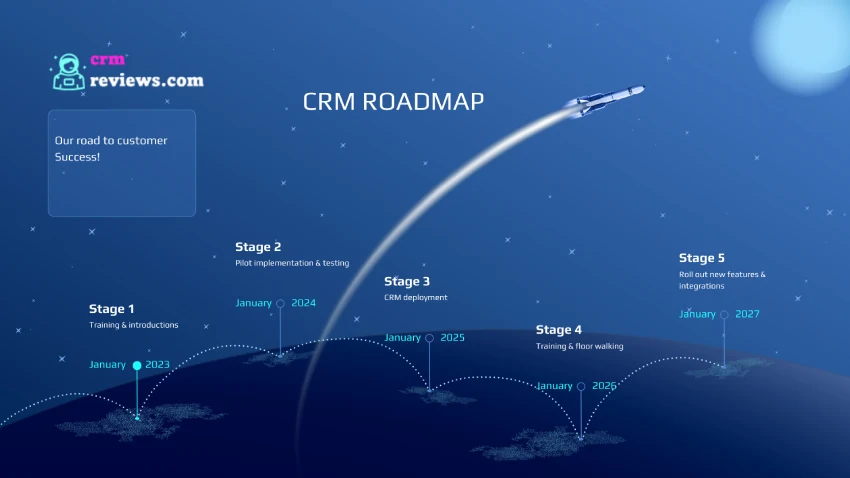
Customer Relationship Management (CRM) is not just software—it’s a strategic business philosophy. Yet, one of the biggest reasons CRM initiatives fail is the lack of a clear, long-term roadmap. Without direction, businesses end up with fragmented systems, poor user adoption, and missed opportunities for customer engagement.
To ensure sustainable growth, ROI, and adoption, organizations must develop a CRM roadmap that aligns business goals, customer needs, and technology evolution. In this guide, we’ll explore the importance of CRM roadmapping, key phases in its development, and how to future-proof your investment for long-term success.
What Is a CRM Roadmap?
A CRM roadmap is a strategic plan that outlines how a business will design, implement, evolve, and scale its CRM system over time. It includes milestones, goals, capabilities, timelines, ownership, and metrics for success.
Rather than treating CRM as a one-time project, a roadmap ensures it’s a living strategy, continuously optimized to meet evolving customer and business needs.
Why You Need a CRM Roadmap
Without a roadmap, CRM projects often fail due to:
- Lack of clarity on goals
- Poor cross-department alignment
- Underutilized features
- Over-customization
- Resistance to change
A structured CRM roadmap delivers:
- Clear direction for implementation and scaling
- Stakeholder buy-in through visible planning
- Better user adoption with structured training and phased rollout
- Alignment with customer experience goals
- Measurement frameworks for ongoing optimization
Core Components of a Successful CRM Roadmap
To build an effective CRM roadmap, include the following components:
1. Vision and Objectives
Define the high-level strategic vision for your CRM. This must reflect:
- Business goals (e.g., increase customer lifetime value)
- Operational efficiency targets
- Enhanced customer experience ambitions
- Digital transformation alignment
Example: “Create a unified CRM that enables personalized customer engagement, automates 70% of sales tasks, and increases cross-sell revenue by 25% in 24 months.”
2. Stakeholder Alignment
Engage stakeholders from all relevant departments:
- Sales
- Marketing
- Customer Service
- IT
- Finance
- Operations
CRM is a cross-functional initiative. Every team’s input is critical to defining priorities and ensuring buy-in.
3. Current State Assessment
Conduct a comprehensive CRM audit to evaluate:
- Existing tools and platforms
- Data silos and integration gaps
- Workflow inefficiencies
- User satisfaction and adoption rates
- Compliance and security concerns
Gap analysis between current state and desired outcomes is foundational for roadmapping.
4. Future State Design
Define the ideal CRM environment that meets long-term needs, including:
- Functional requirements (e.g., lead scoring, automation, omnichannel engagement)
- Technology stack and integrations
- Data architecture
- User roles and permissions
- Governance policies
This becomes the blueprint for your roadmap.
5. Milestones and Timeline
Break the roadmap into phases or milestones such as:
- Phase 1: CRM implementation and data migration
- Phase 2: Sales automation and pipeline setup
- Phase 3: Marketing automation integration
- Phase 4: Customer service workflow integration
- Phase 5: Analytics, AI, and continuous optimization
Assign realistic timelines to each phase with key performance indicators (KPIs) for measurement.
6. Resource Planning
Identify the resources needed at each stage:
- Internal team members and champions
- CRM vendor or consultants
- Budget for licenses, integrations, training
- Change management and communications planning
7. Training and Adoption Strategy
User adoption is the lifeblood of CRM success. Your roadmap should include:
- Role-specific onboarding programs
- Internal “CRM champions” or power users
- Gamification and incentives for use
- Ongoing training and refreshers
8. Continuous Improvement Framework
CRM is not a one-time project. Include a process for:
- Regular review of KPIs and usage data
- User feedback loops
- Agile improvements and iteration
- Future capability expansion (AI, chatbots, personalization)
How to Build a CRM Roadmap in 7 Steps
Step 1: Establish the CRM Leadership Team
Create a cross-functional team responsible for driving the CRM vision, planning, and execution.
Step 2: Define Business Objectives and KPIs
Tie your roadmap to clear, measurable business goals. Common CRM KPIs include:
- Lead-to-customer conversion rate
- Average deal size
- Customer retention rate
- NPS/CSAT scores
- CRM usage and login frequency
Step 3: Audit Existing Systems and Processes
Map your current CRM and customer engagement ecosystem to identify:
- Redundancies
- Process inefficiencies
- Broken workflows
- Data inconsistencies
Step 4: Prioritize Capabilities and Features
Use a prioritization model (like MoSCoW: Must-have, Should-have, Could-have, Won’t-have) to define:
- Essential features for launch
- Integrations (ERP, email, marketing, customer support)
- Automation needs
- Scalability requirements
Step 5: Create the Timeline and Phases
Lay out your phased plan with goals for each milestone. Consider short-, mid-, and long-term plans (e.g., 3, 6, 12, 24-month views).
Step 6: Implement with Agility
Use agile methodologies for your CRM rollout:
- Break phases into sprints
- Pilot with a small group
- Refine before full-scale deployment
Step 7: Monitor, Evaluate, and Evolve
Set up dashboards and reporting tools to monitor usage, performance, and business outcomes. Use this data to refine your roadmap continuously.
Common Pitfalls to Avoid in CRM Roadmapping
- Ignoring end-user input: Leads to poor adoption and misaligned functionality
- Focusing only on technology: CRM success depends on people, processes, and data
- Over-customization: Makes upgrades and scalability difficult
- Skipping training: Undermines usage and ROI
- Lack of change management: Resistance can derail even the best systems
CRM Roadmap Example: 12-Month Outline
| Phase | Timeframe | Goals | Key Deliverables |
|---|---|---|---|
| Phase 1 | Months 1–3 | CRM vendor selection, data audit | Tool selection, migration plan |
| Phase 2 | Months 4–6 | Core CRM setup, team onboarding | Pipeline, dashboards, user roles |
| Phase 3 | Months 7–9 | Automation & integration | Marketing, support, ERP integration |
| Phase 4 | Months 10–12 | Optimization & analytics | AI tools, performance reviews, feedback loops |
Tools to Support CRM Roadmap Development
- Miro / Lucidchart – for visual journey mapping
- Monday.com / Asana – project planning and task tracking
- Power BI / Tableau / Zoho Analytics – KPI tracking dashboards
- Salesforce, HubSpot, Zoho CRM – CRM platforms with roadmap and automation support
- Confluence / Notion – documentation and collaboration hub
Conclusion: CRM Roadmaps Are the Blueprint for Sustainable Success
Without a roadmap, CRM becomes just another tool. But with a well-crafted roadmap, it becomes a powerful driver of customer loyalty, sales growth, and operational excellence. A strategic CRM roadmap connects business goals, user needs, and digital transformation into a cohesive journey that ensures your investment delivers long-term value.